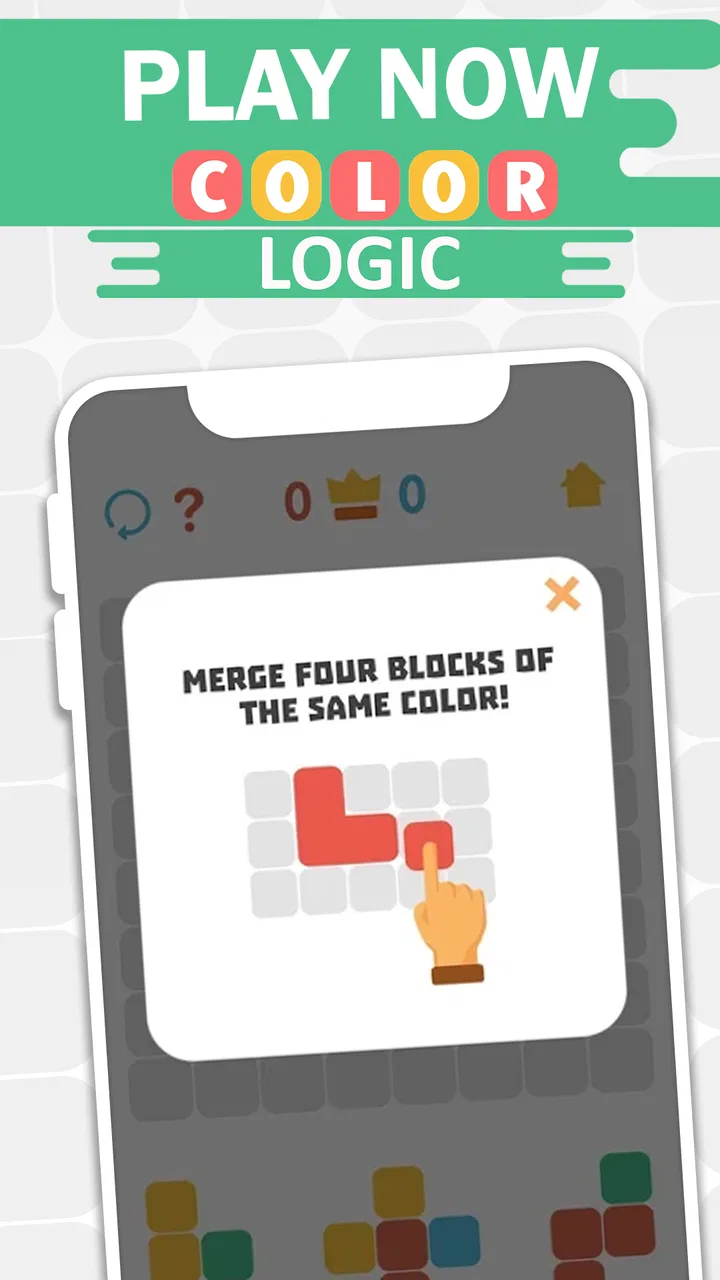
Color Logic
- 4.6
- Rating
- 500.00K
- Installs
- Free
- Price

 Analysis by App-foxy
I first approached Color Logic as the sort of puzzle game that could fill a few quiet minutes, but it quickly made more sense as a shared household option. Its central appeal is simple: it turns color recognition and visual reasoning into a calm, repeatable activity that does not require a long explanation before someone can begin. That makes it easy to pass between people on the same device, whether I am waiting for dinner, taking a short break, or handing the phone to someone who wants a low-pressure game.
Developed by Gimica GmbH, this free puzzle game is aimed at Everyone and runs on Android devices using version 7.0 or later. It has reached more than one hundred thousand installs and holds a 4.5 average from roughly twelve thousand ratings, which gives it a useful level of community feedback without making the game feel like an enormous, crowded platform. The current version is 1.13.1, and the store summary describes it as a color-matching experience built around color logic.
How it works when one device serves several people
The strongest household use case is informal sharing rather than organized multiplayer. I can imagine one person solving a puzzle while another watches, suggests a move, or takes over after a mistake. Because the game is based on visual decisions instead of a complicated control scheme, a child, parent, or occasional player can understand the basic interaction quickly. That is more convenient than passing around a strategy game with a long tutorial or a competitive title that expects everyone to know the rules.
You May Also Like

 Blood Strike: 2.5 Anniversary
Blood Strike’s Loadouts Turn Every Drop Into a Tactical Gamble
A close look at Blood Strike’s custom loadouts: how fast access to signature weapons reshapes its battle royale rhythm, rewards preparation, and narrows the gap between fights.

 Pandora - Music & Podcasts
Pandora’s Music Is Easy to Start, but Harder to Recover
Pandora’s strength is its low-effort path from a seed to a station. Its weak spot is how much confidence it asks you to place in connection, setup, and quiet recovery.

 8 Ball Pool
 Is Built on Rivalries, Rematches, and Routine
A close look at the rivalries, rematches, shared routines, and unanswered safety questions that turn a quick pool match into a persistent mobile community.

 Samsung Music
’s Quiet Strength Is Playing What You Already Own
Its reach comes less from spectacle than from dependable access to a personal library. That simplicity is both the app’s strongest retention engine and its ceiling.

 AccuWeather: Weather Radar
AccuWeather Review: A Quick, Clear Forecast for Everyday Decisions
For everyday plans, the best forecast is the one you can understand quickly. AccuWeather makes rain timing, radar, and local conditions easy to act on, with a few trade-offs.

 Hill Climb Racing
Why Hill Climb Racing Still Turns Crashes Into One More Run
A tiny car, a bumpy hill and one more upgrade: Hill Climb Racing keeps resurfacing because its simple chaos makes every near-miss feel personal.
More From Our News Desk
View All News


This also makes the game suitable for short turns. A shared phone or tablet does not need to become a dedicated entertainment station. One person can play while waiting for an appointment, then leave the device for someone else without creating a large commitment. I like that rhythm because it keeps the game from taking over the room. It works as a small shared activity rather than demanding that the household schedule time around it.
There is a useful distinction between watching and helping. With color puzzles, another person can often see a possible relationship on the screen before the player does. That creates a natural conversation: one person notices a matching opportunity, while the other decides whether the suggestion actually fits the puzzle. In my experience, this is more pleasant than a game where spectators can only wait for a turn.
At the same time, I would not treat it as a full family game in the traditional board-game sense. The appeal comes from solving visual problems, not from a shared scoring system or a structured group mode. If your household wants direct competition, team rules, or a clear winner at the end of a session, a dedicated multiplayer puzzle will probably be a better match. Color Logic is more comfortable as a turn-taking brain exercise.
The first session and the limits of setup
The low barrier to entry is one of its practical strengths. Since the game is free and belongs to the puzzle category, I can recommend trying it without asking someone to make a purchase first. The Everyone age rating also makes it easier to consider for a mixed-age device, although an age label should not be mistaken for a promise that every person will enjoy the same visual challenge.
For a shared device, I would establish a simple routine before anyone starts. Decide who is playing first, agree that hints or suggestions are optional, and avoid treating a difficult puzzle as a test of intelligence. Those boundaries are not app features; they are small household habits that make a color-based game more comfortable for different ages and abilities. They also prevent the most common source of friction: one person taking over while another is still trying to reason through the screen.
The game is especially easy to introduce when the device is already familiar. A child who knows how to use a phone can usually focus on the puzzle rather than learning a new control language. For an older relative, I would spend a moment checking whether the colors are easy to distinguish on that particular screen. Brightness, glare, and display settings can affect a color-matching task more than they affect a word puzzle, so the physical environment matters.
There is also a trade-off in using a single device. A phone is convenient, but its smaller display can make color relationships harder to inspect when several people are looking together. A tablet-sized screen would be more comfortable for a group, but the game itself does not turn the device into a shared board. If your main plan is two or three people solving side by side, screen size may matter more than the app’s low entry cost.
Coordinating turns without making the puzzle stressful
I found that the best way to share a color puzzle is to give each player a complete attempt rather than interrupting every decision. Constant advice can make the game feel like a test supervised by someone else. A better arrangement is to let the current player inspect the board, explain what they see, and invite suggestions only when they want them. This preserves the reasoning part of the experience, which is where the game earns its place in the puzzle category.
For younger players, adults can use questions instead of answers. Asking which colors appear related, what has already been tried, or which area looks most constrained encourages observation without turning the session into a lecture. This is a concrete advantage over many fast arcade games: the pace leaves room for discussion. It also means the same puzzle can be approached at different levels, with one player concentrating on recognition and another thinking about the order of moves.
For adults sharing the device, a useful approach is to keep a loose rotation rather than a formal score sheet. The game is better suited to personal progress and moment-to-moment solving than to a household leaderboard. A written score can add fun for some groups, but it can also shift attention away from the visual logic. I would only add competition if everyone enjoys it; otherwise, the game’s calm pace is more rewarding when the objective is simply to finish a challenging arrangement.
One non-obvious benefit is that the game can expose different ways of looking at the same problem. A player who notices subtle color relationships may move quickly, while someone else may be stronger at checking whether a proposed match creates a later problem. Sharing the screen turns those differences into a conversation. That makes it useful for a parent and child or two adults with different puzzle habits, even though it is not designed as a formal educational tool.
The limitation is that coordination depends on the people using the device. There is no reason to assume that a shared session will automatically be fair, and the game should not be presented as a substitute for a built-in family management system. If you need separate profiles, protected progress, or tightly controlled access, choose an app that explicitly provides those tools. Here, the boundary is social: the household decides how turns and expectations work.
Age, trust, and choosing the right player
The Everyone rating makes Color Logic a reasonable candidate for a mixed-age home, particularly when the goal is a quiet activity rather than an intense action game. I would still introduce it differently depending on the player. A young child may enjoy the immediate visual task, while an adult may appreciate the slower process of checking patterns and avoiding careless choices. The same screen can therefore support different kinds of attention.
For children, I would focus on whether they can distinguish the colors comfortably and whether they enjoy solving without constant rewards or rapid movement. A child who wants characters, stories, or dramatic feedback may lose interest even if the puzzle is technically accessible. Conversely, a child who likes sorting, matching, and spotting relationships may find the restrained format satisfying.
For older adults, the important question is not simply whether the rules are easy. Color perception varies, and similar shades can become tiring when the screen is dim or reflective. I would test the game in the room where it will actually be used, increase screen brightness if appropriate, and avoid assuming that a difficulty with one puzzle reflects a lack of ability. This is one of the clearest situations where a word, number, or shape-based puzzle could be a better alternative.
Trust also matters when the device belongs to several people. I would let each player decide whether to continue a difficult attempt or pass it along, rather than editing someone else’s progress without asking. The game’s simple format makes that courtesy especially important because there may be little separation between one person’s session and the next. A shared-device routine should protect personal ownership even when the game itself is casual.
Parents should also distinguish between suitability and supervision. An Everyone rating is helpful context, but it does not tell me whether a particular child will handle frustration well or whether the household is comfortable with the way the device is being used. I would treat the rating as a starting point, then make the final decision based on the child’s age, patience, visual comfort, and the family’s own rules for phone and tablet time.
What makes it different from familiar puzzle alternatives
Compared with a word puzzle, the game removes the need for spelling knowledge and language fluency. That can make it more approachable in a multilingual household or during a shared session where not everyone wants to read instructions. Compared with a number puzzle, it relies less on arithmetic and more on visual discrimination. Those differences are meaningful: the right choice depends on whether your household prefers language, calculation, or color relationships.
It is also less demanding than a traditional logic puzzle that requires remembering a large set of rules. The visual focus gives it an immediate quality, so I can hand the device to an occasional player without expecting them to study a strategy guide. However, that simplicity can become a weakness for people who want deep planning, elaborate progression, or a strong narrative reason to continue. A more complex puzzle title will offer greater variety if the player quickly masters the basic visual idea.
Against fast matching games, Color Logic feels more deliberate. The value is not just in reacting quickly; it is in looking carefully before committing to a choice. That makes it better for a short decompression break than for someone seeking constant stimulation. The trade-off is that players who enjoy speed, sound, and escalating action may experience the calm design as too restrained.
One practical tip is to use it when attention is available but time is limited. Ten quiet minutes can be enough to engage with a puzzle, while a story-driven game may leave me feeling that I have barely started. I would not use it during a moment that requires divided attention, though. Color comparison still needs concentration, and playing while walking, supervising a task, or handling household responsibilities is not a sensible use of it.
The game’s free price also changes how I compare it with alternatives. I can test whether the visual format suits a family without committing money first. That is valuable for a shared device, where one person’s favorite game may not appeal to everyone. Still, free access alone is not a reason to keep it installed. If the household needs offline certainty, account separation, accessibility options, or a particular puzzle style, those requirements should take priority over cost.
Who should install it, and who should skip it
I would recommend Color Logic to someone who enjoys visual sorting, wants a gentle puzzle for short breaks, or needs an easy activity to share informally with another person. It is especially appealing when the device may move between family members and nobody wants a complicated setup. The combination of a free entry point, an Everyone rating, and a straightforward color-centered idea makes it easy to trial with different players.
I would also consider it for households that want a conversation-friendly game. One player can solve while another watches, asks questions, or offers a suggestion. That shared attention is more interesting than simply watching a fast game unfold, because the reasoning remains visible. It can become a small ritual during waiting periods or quiet evenings without requiring a table, pieces, or a separate controller.
I would skip it for players who need a rich story, direct multiplayer competition, extensive character progression, or a puzzle system based mainly on words and numbers. I would also be cautious if the intended player has difficulty distinguishing colors and the device cannot display the differences comfortably. In that situation, a shape- or text-based alternative may be more inclusive and less frustrating.
Another reason to choose something else is if the household wants firm account boundaries. Color Logic is not the app I would select as the foundation of a managed family-device plan. Its value is in the puzzle itself, not in organizing multiple users. Keep it as a casual shared activity, and use a different solution when profiles, protected progress, or explicit supervision tools are central requirements.
My household verdict
After looking at it as both a solo puzzle and a shared-device game, I see Color Logic as a modest but useful addition rather than an all-purpose family entertainment app. Its strongest quality is the way color-based reasoning invites people to look at the same screen together without demanding a complicated explanation. I can recommend it to a friend who wants something calm, inexpensive, and easy to pass around.
My advice is to start with a short session and observe the player, not just the puzzle. Does the color display feel clear? Does the person enjoy thinking carefully, or are they waiting for faster action? In a household, does everyone respect the current player’s turn? Those answers will tell you more than the rating alone. The game can work very well when expectations match its focused design.
Gimica GmbH has positioned this release as a color-logic puzzle, and that narrow identity is both its appeal and its boundary. I would install it for quiet visual challenges, casual cooperation, and brief breaks on an Android device running 7.0 or newer. I would look elsewhere for structured family controls, competitive group play, or a broader puzzle campaign. Within its lane, though, it is an approachable free game that earns a place on a shared device when the household values patience, observation, and taking turns.
FAQs for Color Logic
01What is Color Logic, and how does it work?
Color Logic is an innovative puzzle game designed to challenge your strategic thinking and color-matching skills. The game involves matching and arranging colors to solve increasingly complex puzzles. With intuitive controls and a sleek design, it offers a captivating experience for both casual and dedicated gamers. Its user-friendly interface ensures players of all ages can enjoy the game, making it an ideal choice for anyone looking to improve their cognitive abilities.
02Is Color Logic free to download and play?
Yes, Color Logic is free to download on both Android and iOS platforms. While the core gameplay is available at no cost, there are optional in-game purchases that enhance the experience, such as additional levels or special features. These purchases are entirely optional and designed to support the developers while providing added enjoyment for players who wish to explore more of what the game has to offer.
03Does Color Logic require an internet connection to play?
No, Color Logic does not require a constant internet connection to play. Once downloaded, the game can be enjoyed offline, making it perfect for on-the-go entertainment. However, an internet connection is beneficial for downloading updates and accessing certain features, such as leaderboards and in-app purchases, which enhance the overall gaming experience.
04What are the system requirements for Color Logic?
Color Logic is designed to be accessible on a wide range of devices. For Android users, a device running Android 5.0 or higher is recommended. iOS users will need a device with iOS 11.0 or later. The game is optimized to run smoothly on both smartphones and tablets, ensuring a seamless experience across different screen sizes.
05Are there any accessibility features in Color Logic?
Yes, Color Logic includes several accessibility features to ensure an inclusive gaming experience. The game offers adjustable color contrast settings for players with color vision deficiencies. Additionally, it provides options for simplified controls and audio cues, making it more accessible to players with different needs. These features are part of the developers' commitment to making the game enjoyable for everyone.
Pros
- Intuitive interface for easy navigation.
- Wide range of color palettes available.
- Customizable color schemes.
- Supports multiple export formats.
- Regular updates with new features.
Cons
- Limited free version features.
- Occasional bugs in color picker.
- Requires internet for full access.
- Some features hidden behind paywall.
- High battery consumption on older devices.

Color Logic
Gallery